
Shots on Target
Some shots fly wide, and some make the goalkeeper dive. Shots on target counts the ones that would have gone in with no goalkeeper there. Put it over a team’s total shots, and you have one of the first fractions analysts check.
About a 4-minute read.

Start with one match
Out of all the shots, how many were on target?
A shot is on target if it would have gone in with no goalkeeper there. That means every goal and every save. Shots that go wide, fly over, or get blocked by a defender aren’t on target. Neither are shots that hit the post or crossbar and bounce out: even with no goalkeeper, they’d have missed.
On Matchday 14 of the Riverfield League, our fictional league, the Turtles took 10 shots against the Bees, and 5 of them were on target. That’s 5 shots on target. Put it over all the shots and you get a fraction: 5/10, or 5 out of 10.
5/10 = 5 shots on target out of 10
- Shot 1: Goal
- Shot 2: Off target
- Shot 3: Saved
- Shot 4: Saved
- Shot 5: Off target
- Shot 6: Blocked
- Shot 7: Saved
- Shot 8: Saved
- Shot 9: Off target
- Shot 10: Off target
Try it
Take some shots and build the fraction
Tap anywhere around the goal to take a shot. Shots inside the frame count as on target. Shots that miss, hit the post or crossbar, or get blocked don’t. Each new shot changes the fraction.
- On target
- Not on target
Tap or click to shoot, or use the arrow keys and Enter.Tap to shoot. The goal is drawn to scale: 7.32 meters wide and 2.44 meters high (24 by 8 feet). Each net square is 1 foot.
On target so far
3 out of 6
That’s 3/6 of your shots.
- Shot 1: on target
- Shot 2: off target
- Shot 3: on target
- Shot 4: off target
- Shot 5: blocked
- Shot 6: on target
Up to 10 shots. Red ones were on target.
Exactly half of your shots were on target.
Next shot
What counts as on target
-
Scored or saved
On target. The ball was heading into the goal, so it counts whether the goalkeeper stopped it or not.
Try it: tap anywhere inside the frame.
-
Wide or over
Not on target. The shot missed the goal completely, so there was nothing for the goalkeeper to stop.
Try it: tap outside the goal.
-
Off the post or crossbar
Not on target. The ball hit the frame of the goal (a post, or the crossbar across the top) and bounced out, so it would have missed even with no goalkeeper there.
Try it: tap right on a post.
-
Blocked
Not on target. A defender got in the way before the ball reached the goal, even if it was heading in.
Try it: switch Next shot to Blocked, then tap the goal.
Data providers handle a few rare cases differently, like a shot a defender stops right on the goal line. The Riverfield League almanac counts every goal and every save as on target, and nothing else.
What it doesn’t tell you
On target doesn’t mean it was a good chance
Shots on target only tells you where the ball went, not how good the chance was. A shot from far out that the goalkeeper catches easily counts as on target. A penalty kick that flies wide doesn’t.
That’s why analysts look at shots on target next to expected goals, which rates the chance.
How hard a shot on target was to save is a different stat again, called expected goals on target.
How expected goals worksOn Matchday 2, a Bees shot from 31 meters out had 0.01 expected goals, and the Owls’ goalkeeper saved it. On Matchday 1, a Robins penalty kick had 0.79 expected goals and went wide. Which shot was on target? Which was the better chance?
The Bees’ shot was on target, because the keeper had to save it. The penalty was the better chance: shots like it go in about 79 times out of 100.
A whole match
Compare two teams’ shots on target
Count each team’s shots, then the ones on target. Putting one over the other shows how often each team’s shots were heading into the goal, even when the two teams took different numbers of shots.
The Foxes put 8 of 9 shots on target and didn’t score
On Matchday 1, the Foxes put 8 of their 9 shots on target. The Turtles put 4 of their 9 on target, scored once, and won 1–0.
The Turtles’ goalkeeper saved all 8. Making the goalkeeper work is a good sign, but it isn’t the same as scoring.
Racing Foxes 0–1 Turtles Athletic
Riverfield League · Matchday 1
Racing Foxes · 9 shots
8/9on target
8 on target, and the keeper saved all 8!
Turtles Athletic · 9 shots
4/9on target
4 on target, and 1 went in
What could explain it? The Foxes made the goalkeeper work all match, and the Turtles’ goalkeeper was ready every time. Over the season, the Turtles’ goalkeeper saved 45 of the 55 shots on target the Turtles faced. To compare goalkeepers, analysts turn that fraction into a percentage, which means out of 100: 45/55 is about 82 out of 100, or 82%. Analysts call it save percentage, and 82% was the best in the league. Excellent goalkeeping isn’t luck.
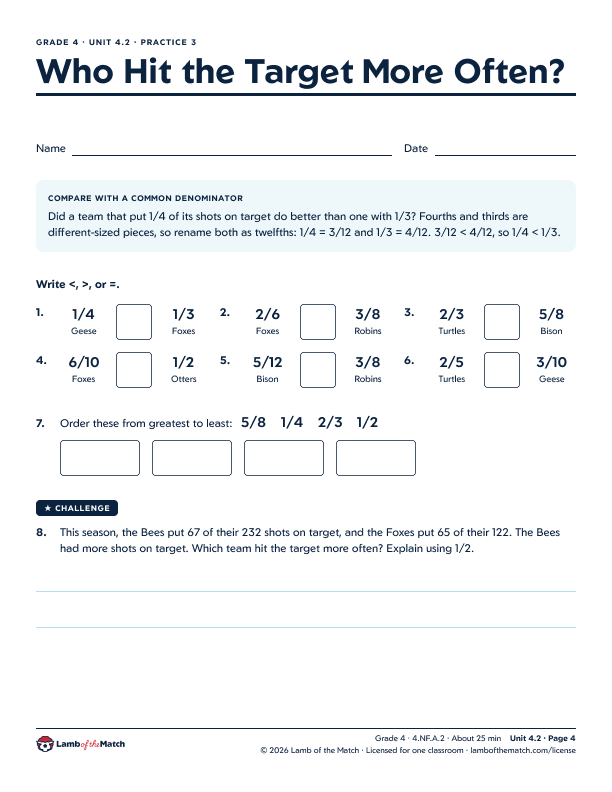
Over the whole season, the Foxes and the Bees put almost the same number of shots on target: 65 and 67. But the Bees took 232 shots to get there, the most in the league, and the Foxes took only 122. As percentages, the Foxes’ 65/122 is about 53% and the Bees’ 67/232 is about 29%. Analysts call this shot accuracy. The Foxes’ 53% was the best in the league, and the Bees’ 29% was the lowest.
A team that shoots more usually has more shots on target. A percentage shows how often a team’s shots were on target out of 100, so it’s fairer for comparing teams that took different numbers of shots.
In the classroom
Teach it with Fractions through Shots on Target
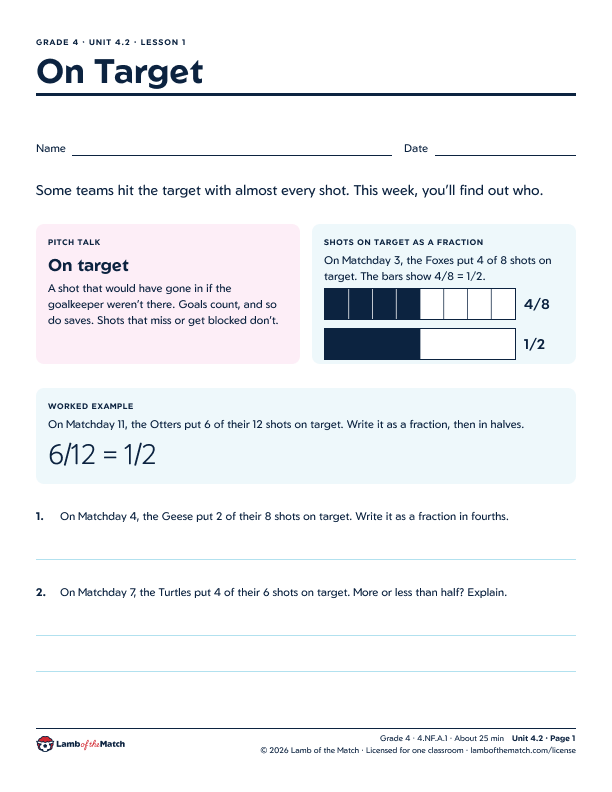
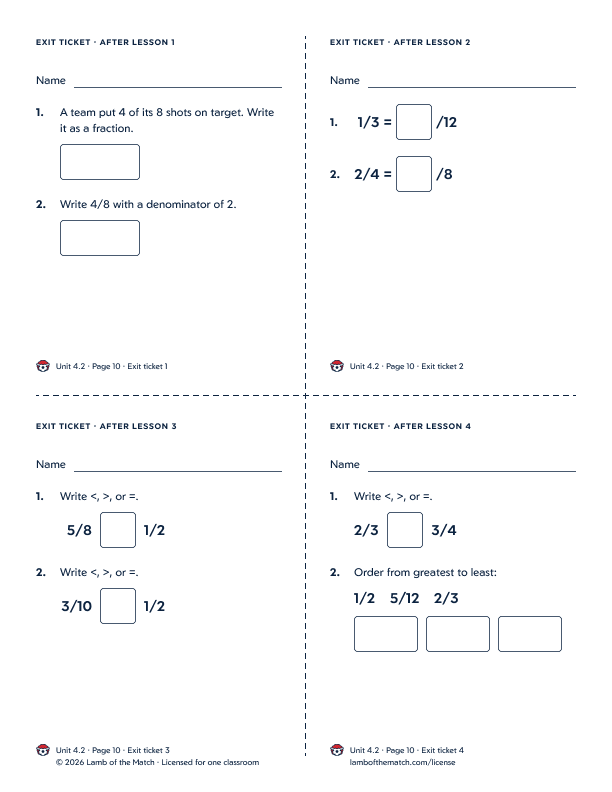
Grade 4, Unit 4.2 turns shots on target into lessons on equivalent and comparing fractions, all set in the Riverfield League.
Print-at-home PDFs, licensed for one teacher’s classroom.