

Expected Assists
Most shots start with a pass. Expected assists gives that pass credit for the shot it set up: the pass gets the shot’s expected goals, whether the shot goes in or not.
About a 5-minute read.

Start with one pass
How good was the shot this pass set up?
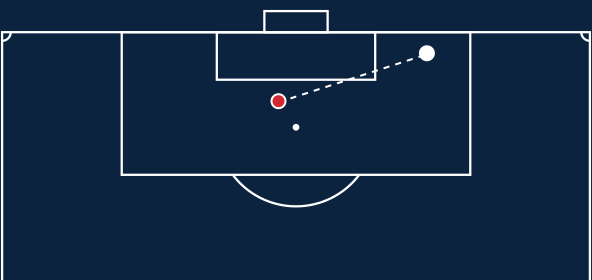
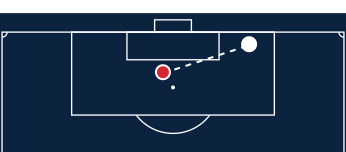
When a pass leads straight to a shot, analysts give the pass credit equal to the shot’s expected goals. That credit is called expected assists.
Say a pass sets up a shot that goes in about 45 times out of 100. The shot has 0.45 expected goals, so the pass gets 0.45 expected assists, whether the shot goes in or not.
0.45
expected goals for the shot = 0.45 expected assists for the pass
- Goes in
- Doesn’t go in
Try it
Move the pass and see who gets what
Drag the shooter to where the pass arrives, and drag the passer anywhere you like. Watch which one changes the number. Then see what a header or a defender closing in does.
Drag either player or use the arrow keys (Tab switches between them). Numbers are estimates from the shot’s distance and angle, rounded.
Drag either player. Numbers are estimates from the shot’s distance and angle, rounded.
The shot this pass set up goes in about
45 out of 100
So the pass gets 0.45 expected assists.
- Goes in
- Doesn’t go in
Shot taken with
Nearest defender
What the pass gets credit for
-
Where the shot is taken
A pass that sets up a shot close to goal and straight in front earns the most, because shots from there go in most often.
Try it: drag the shooter toward the goal.
-
Not where the pass starts
A long pass and a short one get the same credit if they set up the same shot. Expected assists only looks at the shot.
Try it: drag the passer anywhere. The number stays put.
-
A header or a foot
A cross that sets up a header earns less than a pass to the same spot for a shot with a foot. Headers go in less often.
Try it: switch to Head.
-
A defender closing in
If the shooter gets the ball with a defender closing in, the shot is rushed, and the pass earns less.
Try it: switch Nearest defender to Closing in.
The number uses the same model as the Expected Goals page: the shot’s distance and angle, foot or head, and a defender. A pass that doesn’t lead to a shot gets no expected assists. Some analysts also rate every pass by how often passes like it lead to goals, which is a different stat.
What it doesn’t tell you
Only the pass right before the shot gets credit
Expected assists goes to one pass: the one that set up the shot. The passes before it get none, and so do shots that come from a solo run, a rebound, or a penalty kick, because no pass set them up.
It’s also set when the shot is taken. A pass keeps its credit whether the shot goes in or not, so a great pass can earn a lot with no assist to show for it.
The Riverfield League doesn’t name its players yet, so this page adds expected assists up by team.
How expected goals worksOn Matchday 3 of the Riverfield League, our fictional league, the Bison took two shots against the Bees. One came from a through ball, had 0.56 expected goals, and was saved. The other came from a solo run, had 0.31 expected goals, and went in. How many expected assists does each one give?
The through ball gets 0.56, even though the shot was saved. The solo run gives 0, because no pass set it up, even though it was a goal.
A whole match
Add up the passes to get a team’s expected assists
Add the expected goals of every shot a teammate set up with a pass. That total is the team’s expected assists. Shots nobody set up still count toward expected goals, but not toward expected assists.
Nearly every Bison shot started with a pass
On Matchday 3, the Bison beat the Bees 5–0. Their 19 shots added up to 3.97 expected goals, and 3.66 of that came from shots a teammate set up. That 3.66 is the Bison’s expected assists.
The Bees’ 14 shots added up to only 0.66 expected goals, and just 0.26 came after a pass. Most of the Bees’ biggest shots came from players going it alone.
Bison FC 5–0 Dynamo Bees
Riverfield League · Matchday 3
- Set up by a pass (expected assists)
- No pass
Bison FCBison · 19 shots, 3.97 expected goals
3.66 expected assists 92% of their expected goals
Set up by: Passes 1.63 · Through balls 1.17 · Crosses 0.54 · Corners 0.32
Dynamo BeesBees · 14 shots, 0.66 expected goals
0.26 expected assists 39% of their expected goals
Set up by: Corners 0.14 · Crosses 0.09 · Passes 0.02 · Free kicks 0.01
To compare teams, analysts turn it into a share of the team’s expected goals. For the Bison, 3.66/3.97 is about 92%. For the Bees, 0.26/0.66 is about 39%. A high percentage means the passing made the shots; a low one means players made shots on their own. It tells you how a team creates shots, not how good they are.
Over the season, almost all of the Geese’s expected goals came from passes: 14.44 of 14.61, about 99%, because they score from crosses, corners, and free kicks. The Bees were lowest, at about 58% (7.19 of 12.31). The Foxes set up 43 shots with through balls, the most in the league, for 6.78 expected assists.
Neither style is right or wrong. These numbers show how a team makes its shots, not how it should.