

Field Tilt
Field tilt asks which team spent more time near the other team’s goal. It counts each team’s touches in its final third, the third of the field nearest the goal it’s attacking, and turns them into shares that add up to 100%.
About a 5-minute read.


Start with one match
Who spent more time in the other team’s end?
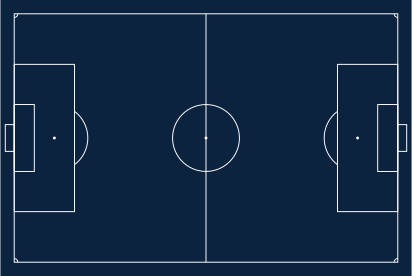
Split the field into thirds. A team’s final third is the third nearest the goal it’s attacking. Every time a player touches the ball there, it counts.
On Matchday 10 of the Riverfield League, our fictional league, the Otters touched the ball 229 times in their final third, and the Turtles only 59. Field tilt is each team’s share of those touches: 229 out of 288, about 80%. The Turtles’ share was about 20%.
80% + 20% = 100% of the final-third touches
- Otters · 80
- Turtles · 20
Try it
Count the touches near goal
Field tilt is each team’s final-third touches out of both teams’ final-third touches. Change either count and watch the shares move.
Why the number moves
-
Only the final third counts
Touches in a team’s own end or the middle don’t count. Field tilt only looks near the goal each team is attacking.
Try it: add 100 touches to the Turtles.
-
It always adds to 100%
One team’s share is everything the other team didn’t have. If the Otters have 80%, the Turtles have 20%.
Try it: change one team and watch both numbers move.
-
Not the same as possession
Possession counts the ball anywhere. On Matchday 11, the Bees had 55% of the ball but 66% of the touches near goal.
Try it: pick Bees v Foxes.
-
Pinned back
A team with low field tilt spends most of the match defending near its own goal, by choice or not.
Try it: take 10 touches from the Turtles.
This page measures field tilt the way the almanac does: final-third touches ÷ both teams’ final-third touches. Some analysts count passes in the final third instead, so their numbers can differ a little.
What it doesn’t tell you
Time near goal isn’t the same as good shots
Field tilt shows where a match was played. It doesn’t say whether a team made good shots, or whether the other team let them have the ball on purpose.
The Turtles had the lowest field tilt in the league, about 37% a match, and finished 3rd. They defend deep, let the other team come at them, and trust the best goalkeeper in the league.
To see whether time near goal turned into good shots, look at expected goals too.
How expected goals worksOn Matchday 1, the Otters touched the ball 226 times in their final third. The Owls touched it 140 times in theirs. What was each team’s field tilt?
226 + 140 = 366 touches. Otters: 226/366 ≈ 0.62, about 62%. Owls: 140/366 ≈ 0.38, about 38%.
A whole match
Read field tilt next to possession
Possession says who had the ball. Field tilt says where they had it. Together they show how a match was played.
Pinned back, and still a draw
On Matchday 10, the Otters had 63% of the ball and 80% of the final-third touches. The Turtles spent most of the match defending near their own goal.
It finished 1–1. The Otters’ 11 shots added up to 1.43 expected goals, and the Turtles’ goalkeeper saved 2 of the 3 that were on target.
Riverfield League · Matchday 10
- Possession: Otters United 63%, Turtles Athletic 37%.
- Final-third touches: Otters United 229, Turtles Athletic 59.
- Field tilt: Otters United 80%, Turtles Athletic 20%.
- Shots: Otters United 11, Turtles Athletic 6.
- Expected goals: Otters United 1.43, Turtles Athletic 0.57.
Each bar splits a stat between the two teams. The light blue marks show 50% on possession and field tilt.
Each bar splits a stat between the two teams.
What could explain it? Some teams choose to sit back. The Turtles defend deep, let the other team have the ball near their goal, and trust their goalkeeper. Over the season they had the league’s lowest field tilt, about 37%, and still finished 3rd.
The gap between the two numbers shows where a team’s possession happened. The Otters had 80% of the touches near goal but only 63% of the ball: 80 − 63 = 17 points more. Over the season, the Otters (61%) and Bison (60%) had the highest field tilt and finished 2nd and 1st.
Field tilt is a clue to where a match was played, not to who won it.