
Expected Goals
Some shots go in nearly every time. Some almost never do. Expected goals is the number analysts use to say how likely a shot is to go in, based on thousands of shots like it.
About a 5-minute read.



Start with one shot
Out of 100 shots like this one, how many go in?
Analysts look at thousands of shots taken from the same kind of spot, in the same kind of way. Then they count how many went in.
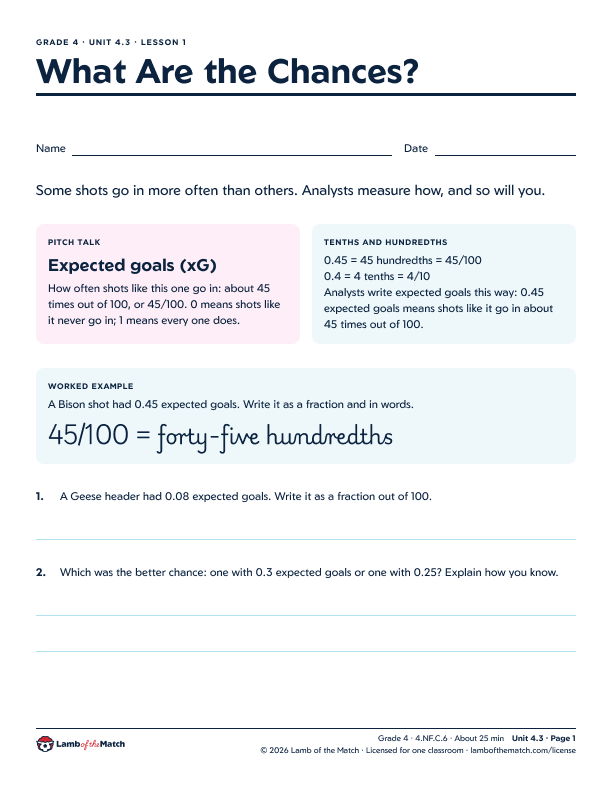
If shots like it go in about 45 times out of 100, analysts write that as 0.45. That number is the shot’s expected goals.
0.45
= 45/100 = forty-five hundredths
- Goes in
- Doesn’t go in
Try it
Move the ball and see what changes
Drag the ball anywhere near the goal. Shots from close in and straight in front go in far more often than shots from far out or from a tight angle. Then see what a header or a defender closing in does to the number.
Drag the ball or use the arrow keys. Numbers are estimates from the shot’s distance and angle, rounded.
Shots like this go in about
45 out of 100
That’s 0.45 expected goals.
- Goes in
- Doesn’t go in
Shot taken with
Nearest defender
Why the number moves
-
How far from goal
Closer is better. Shots from inside the penalty area go in far more often than shots from outside it.
Try it: drag the ball toward the goal.
-
The angle
From straight in front, a shooter sees the whole goal. From out wide near the goal line, there’s only a sliver to aim at.
Try it: drag the ball out wide and watch the blue wedge shrink.
-
Foot or head
From the same spot, headers go in less often than shots taken with a foot. It’s harder to aim with your head.
Try it: switch to Head.
-
A defender closing in
A shooter with time and space can pick a spot. One rushed by a defender has to hurry the shot.
Try it: switch Nearest defender to Closing in.
Real models also look at how the ball arrived (a pass along the ground, a high ball in from the side, or a rebound) and much more. Most don’t look at who took the shot. A penalty kick isn’t estimated at all: every one counts as 0.79.
What it doesn’t tell you
A miss doesn’t change the number
Expected goals is set the moment the shot is taken. It measures how good the chance was, not how well the ball was struck.
A shot from point-blank range that flies 20 yards wide was a great chance and a poor finish.
Analysts rate the finish with a different stat, called expected goals on target.
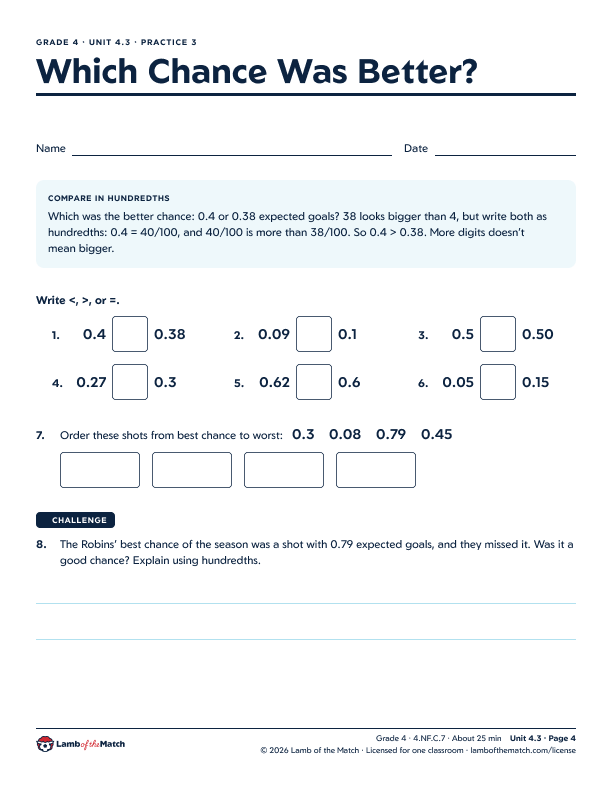
In the Riverfield League, our fictional league, the Robins’ best chance of the season was a shot with 0.79 expected goals, and they missed it. Was it a good chance? Explain using hundredths.
Yes: 0.79 = 79/100, so shots like it go in about 79 times out of 100. The finish was poor, but the miss doesn’t change how good the chance was.
A whole match
Add up every shot to get a team’s expected goals
Add up the expected goals of every shot a team took. The total is how many goals chances like theirs usually produce. Because it’s a total, it can be more than 1.
The shots said one thing, the score said another
Shots like the Robins’ usually produce about 3 goals. Shots like the Geese’s usually produce less than 1. The match finished 1–1.
The Geese scored from a shot with 0.14 expected goals. Shots like that go in about 14 times out of 100, and this one did.
Sporting Robins 1–1 AFC Geese
Riverfield League · Matchday 5
Sporting Robins · 17 shots
Total: 3.05
shots like these: about 3 goals. 1 went in
AFC Geese · 11 shots
Total: 0.86
one 0.14 shot, and it went in!
What could explain it? Apart from their goal, the Robins’ three best shots, with 0.52, 0.36, and 0.33 expected goals, all missed the target. In fact, 11 of their 17 shots did, and the Geese’s goalkeeper had to make only 2 saves. Good chances still get missed, and luck might be part of it too.
The Robins kept doing this all season. Their shots added up to 17.42 expected goals, and they scored 11. Once could be luck. When it keeps happening, analysts look for a reason. For the Robins, it’s the finishing: the shots they put on target added up to about 11.5 expected goals on target, close to the 11 goals they scored. They took good shots and missed too many of them.
No team can score 3.05 goals in a match. Expected goals is what shots like these produce on average.
In the classroom
Teach it with Decimals through Expected Goals
Grade 4, Unit 4.3 turns expected goals into four lessons on tenths and hundredths, all set in the Riverfield League.
Print-at-home PDFs, licensed for one teacher’s classroom.