

Grade 4 · All units
The Grade 4 Bundle
Every Grade 4 unit, from stadium crowds to pitch sizes. Five units for the price of four.

Grade 4 · Unit 4.2
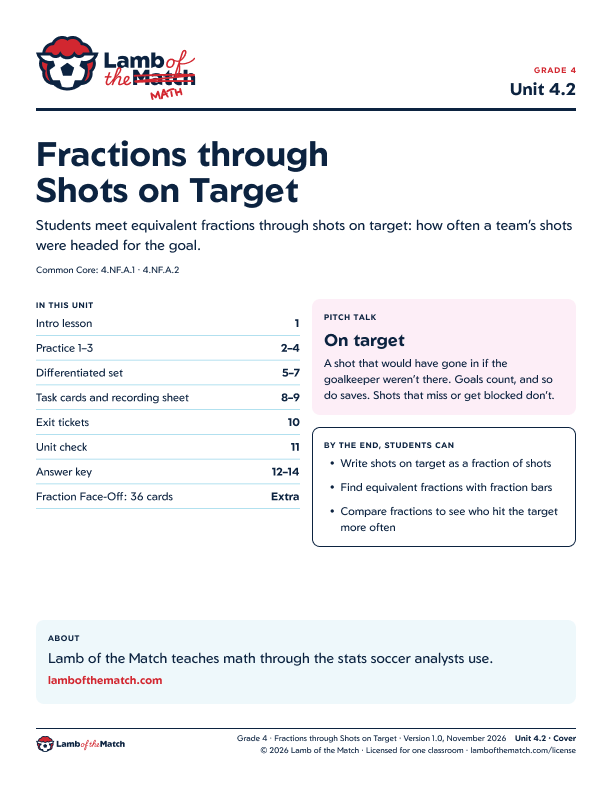
Students meet fractions through shots on target: how often a team’s shots were headed for the goal. They find equivalent fractions with fraction bars and compare fractions to see which team hit the target more often.
Print-at-home PDFs, licensed for one teacher’s classroom. Final sale once downloaded; see returns and refunds. Your order email has the download link.
What kids learn
Three Grade 4 Common Core standards, each practiced with numbers from a soccer season.
On Matchday 3, the Foxes put 4 of 8 shots on target, and 4/8 = 1/2.
The Turtles’ 4 of 6 is more than half: 4/6 > 3/6, and 3/6 = 1/2.
Rename fourths and thirds as twelfths to compare them: 1/4 = 3/12 and 1/3 = 4/12, so 1/4 < 1/3.
The stat behind it
A shot on target would have gone in if the goalkeeper weren’t there. Goals count, and so do saves; shots that miss or get blocked don’t. Shots on target out of all a team’s shots is a fraction.
Read the full explainer4/8 = 1/2 of the shots on target
Try one
The challenge question from the unit’s third practice page. Every problem is set in the Riverfield League, with numbers from its season.
This season, the Bees put 67 of their 232 shots on target, and the Foxes put 65 of their 122. The Bees had more shots on target. Which team hit the target more often? Explain using 1/2.
The Foxes! 65 is more than half of 122 (61), so 65/122 > 1/2. 67 is less than half of 232 (116), so 67/232 < 1/2.
What’s in the pack
Print-at-home PDFs: an intro lesson, three practice pages, a differentiated set at three levels, 12 task cards with a recording sheet, exit tickets, a unit check, a 4-page teacher guide, a 3-page answer key, and Fraction Face-Off.
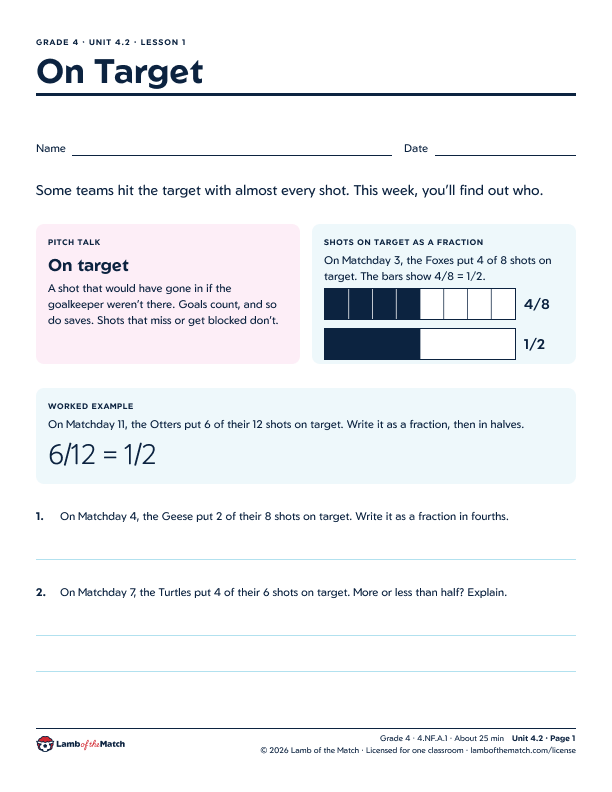
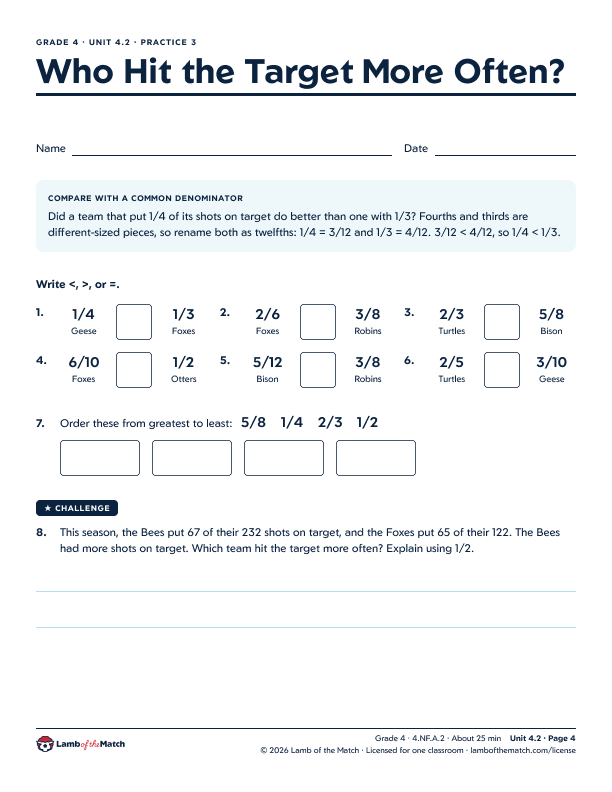
An intro lesson with a Pitch Talk on shots on target, then three practice pages.
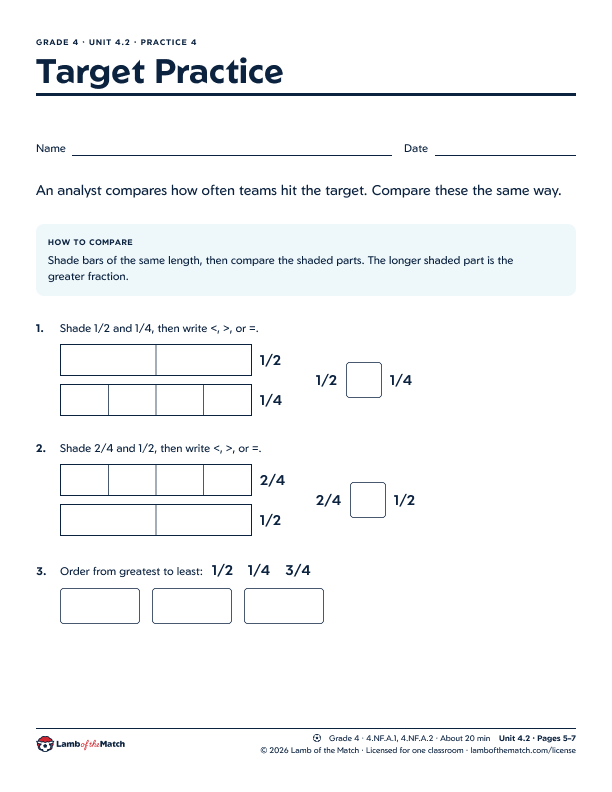
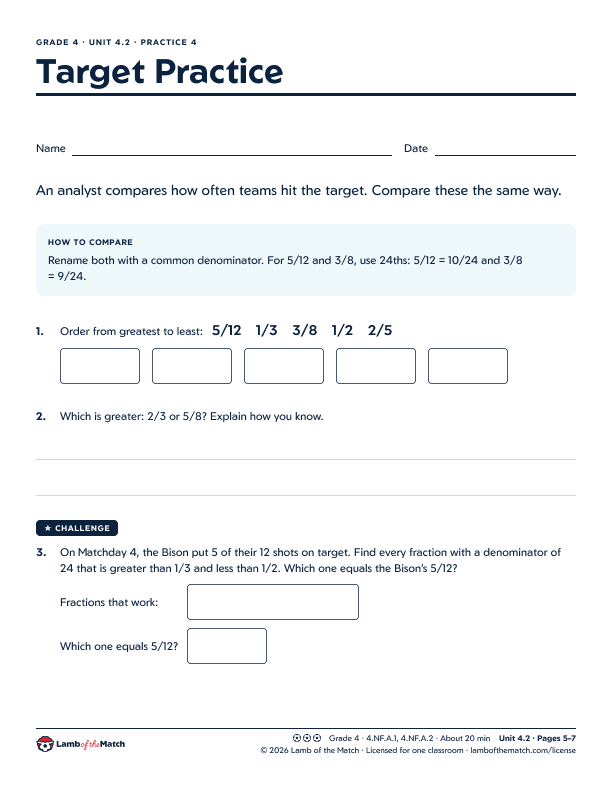
One comparing task at three levels, below, on, and above grade, so the whole class can discuss it together.
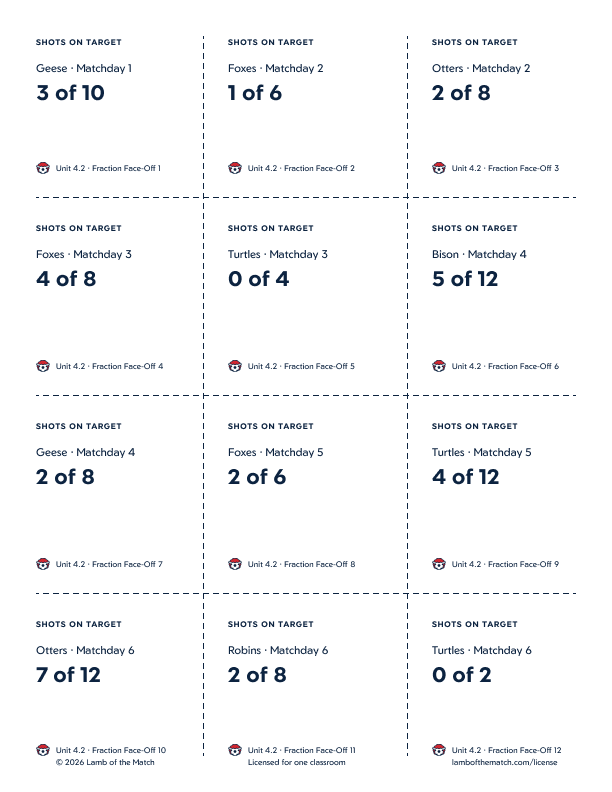
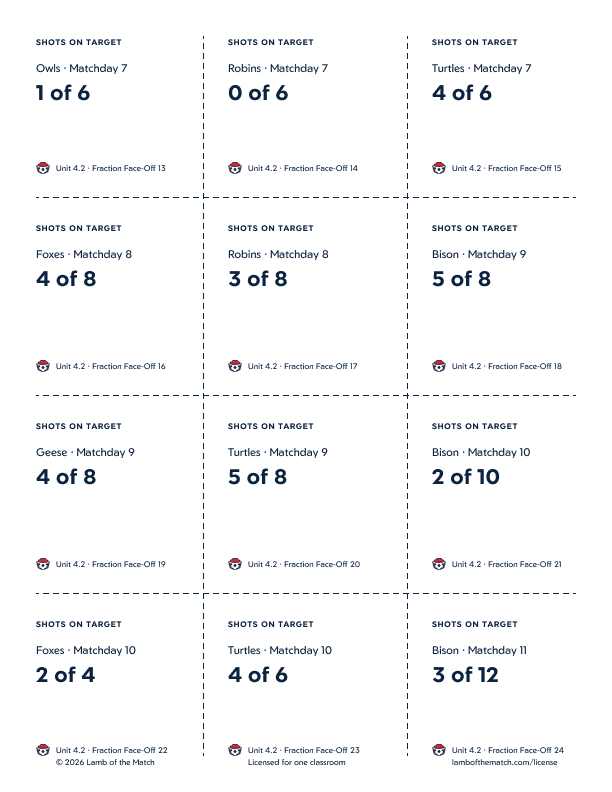
Play in pairs: each player flips a card and writes it as a fraction, and the player with the bigger fraction wins both cards. If they’re equal, each names an equivalent fraction, then both flip again.
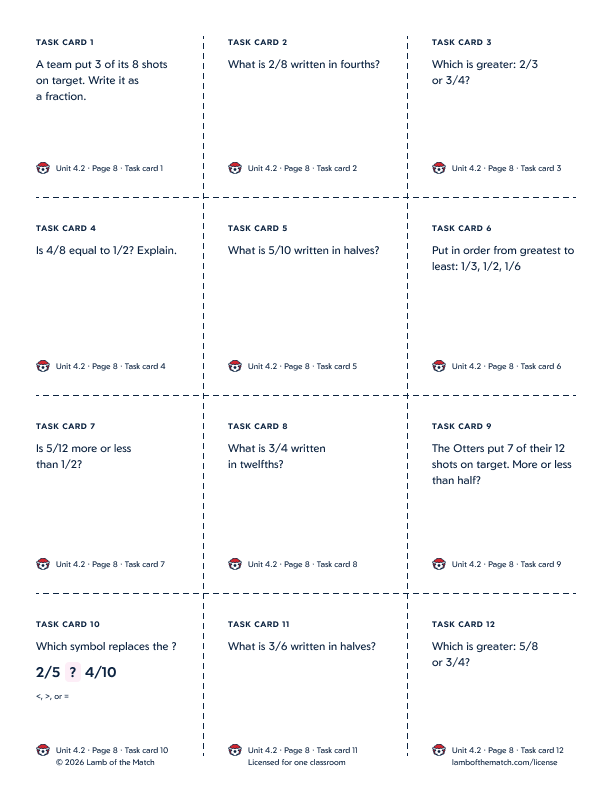
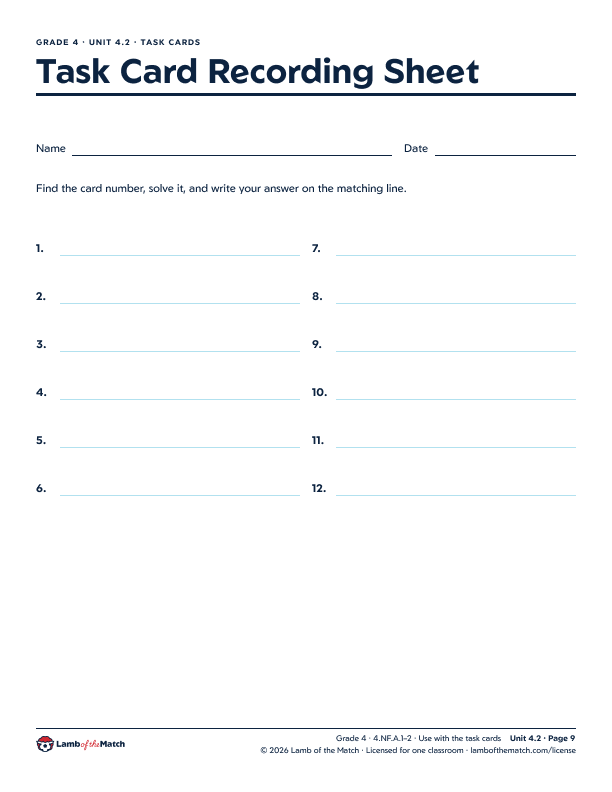
Cut-apart cards for centers or a scoot game, 12 in all, with a recording sheet.
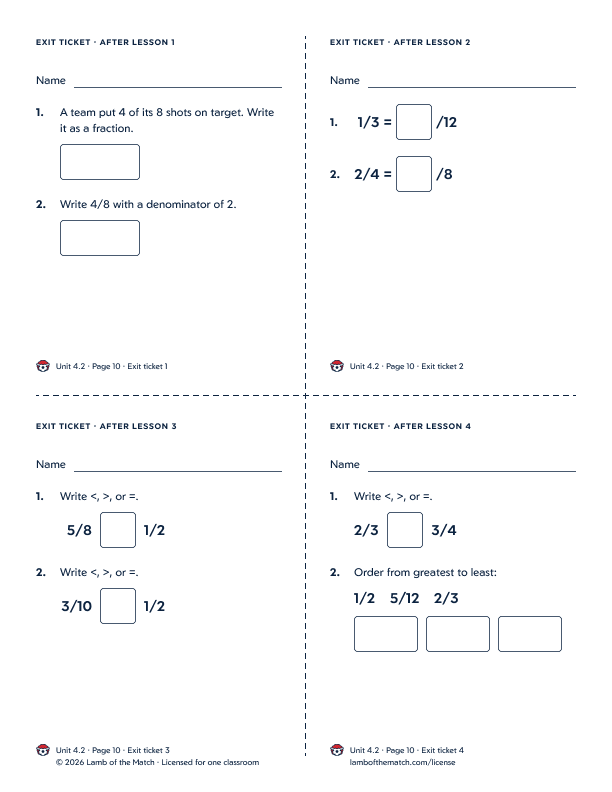
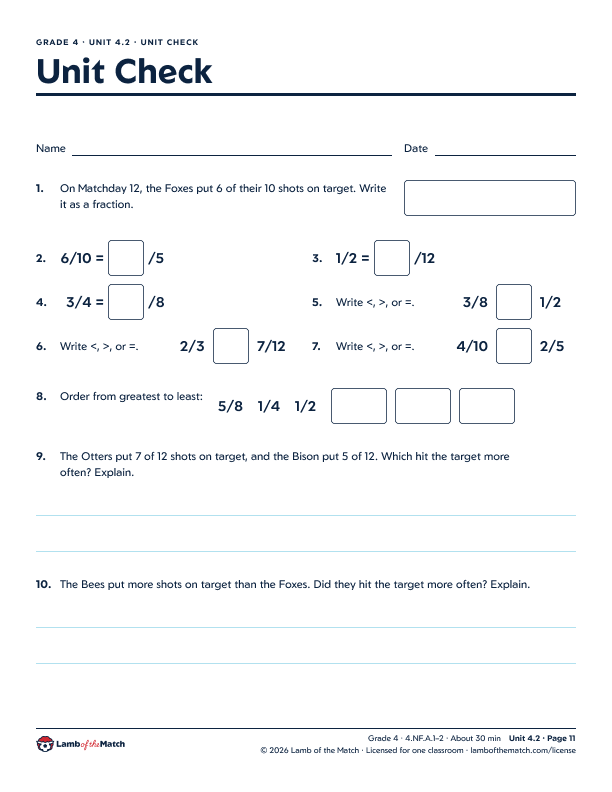
A quick ticket after each lesson, then a 10-question check to close the unit.
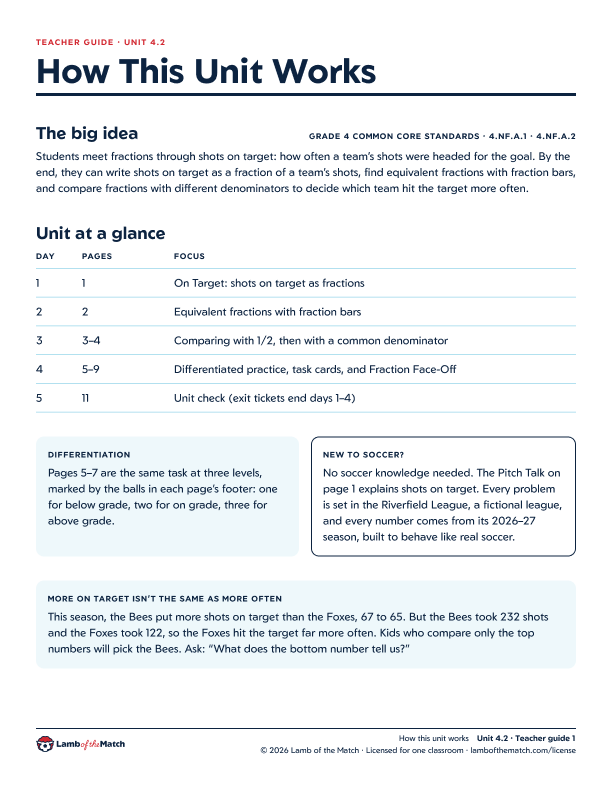
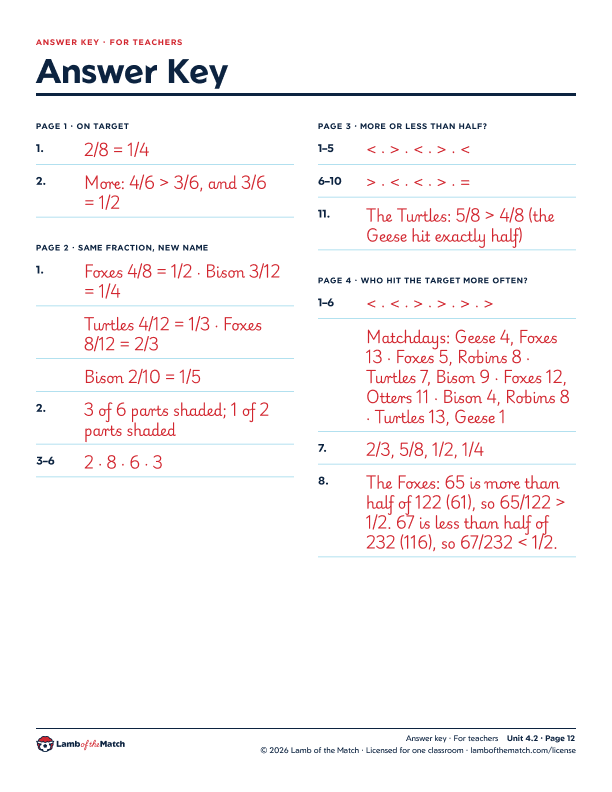
Lesson notes, the game rules, and every answer handwritten in red.
For teachers
Each lesson ends with a quarter-page ticket, so you can see who has it before moving on.
Everyone works on the same task at their own level. Only a small mark in each page’s footer shows the level, so the class can discuss it together.
Denominators stay within Grade 4’s (2, 3, 4, 5, 6, 8, 10, and 12), and big season totals are compared with 1/2 rather than converted.
A Pitch Talk explains shots on target on the first page. Kids who love the game just get more to talk about.
Where it fits
Five units per grade, each built on a different soccer number. Grade 4 is out now, and Grades 3 and 5 are next.
Print-at-home PDFs, licensed for one teacher’s classroom. Final sale once downloaded; see returns and refunds. Your order email has the download link.
Five units per grade
Grade 4
Pick up the next unit, or get the whole grade for the price of four.
Grade 4 · All units
Every Grade 4 unit, from stadium crowds to pitch sizes. Five units for the price of four.
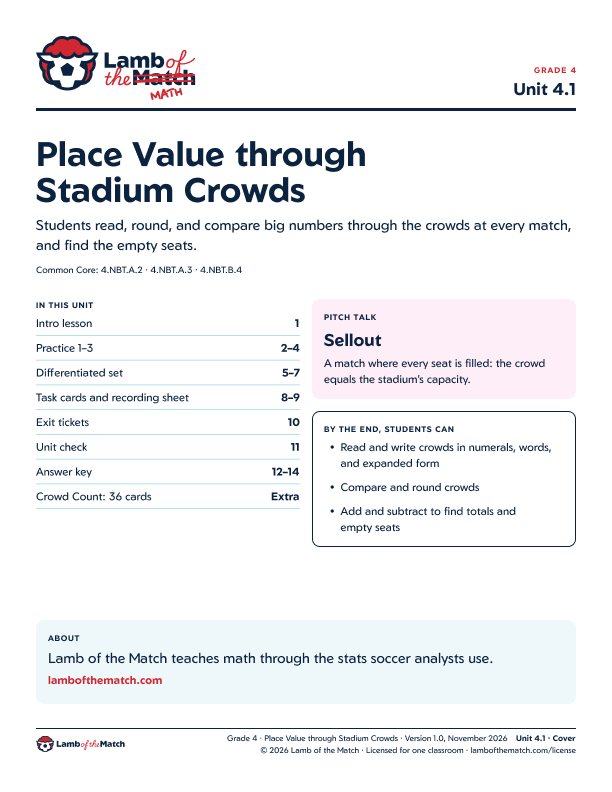
Grade 4 · Unit 4.1
Attendance across a season: place value, rounding, and adding and subtracting big numbers.
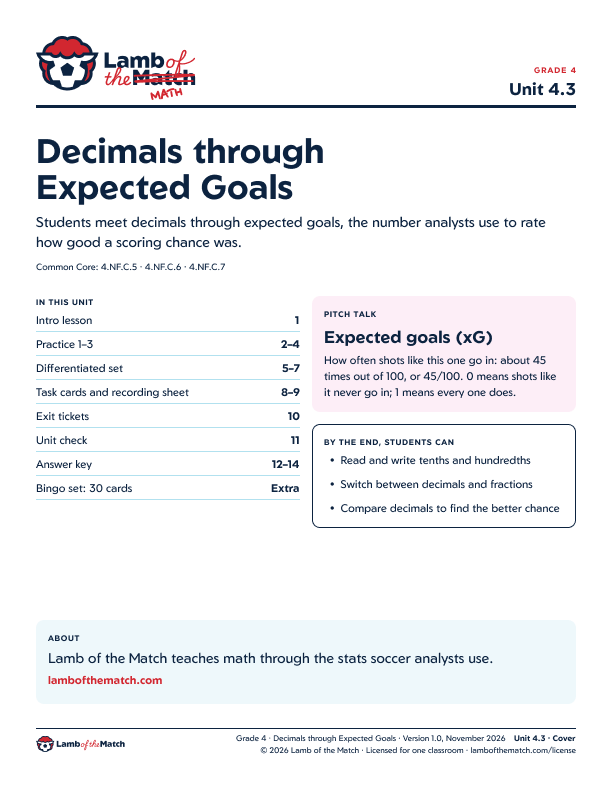
Grade 4 · Unit 4.3
What 0.45 expected goals really means: tenths, hundredths, and comparing decimals.
Your cart is empty.
Find a lesson for your class, or something to wear to the match.