

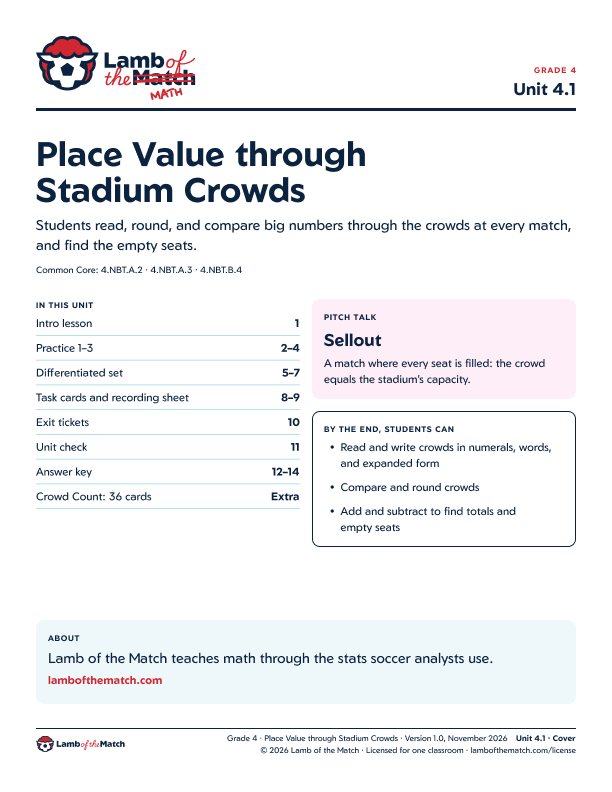
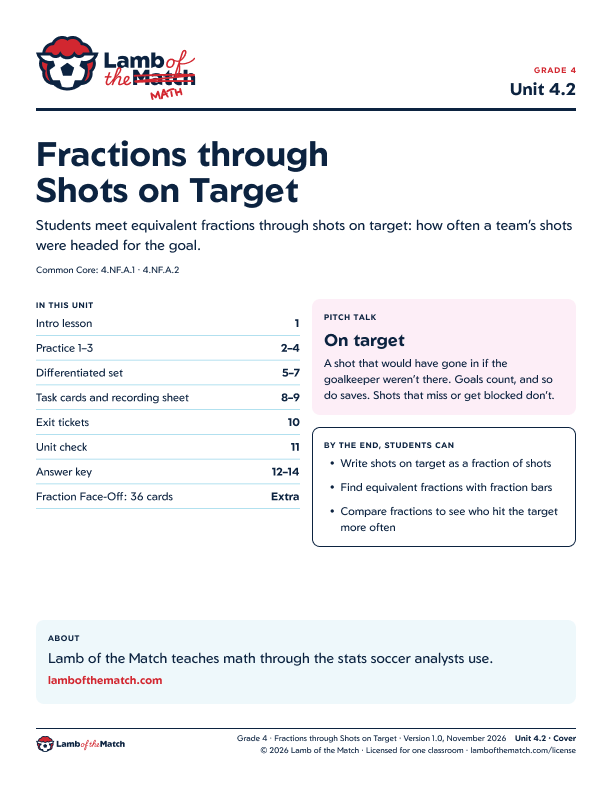
Grade 4 · All units
The Grade 4 Bundle
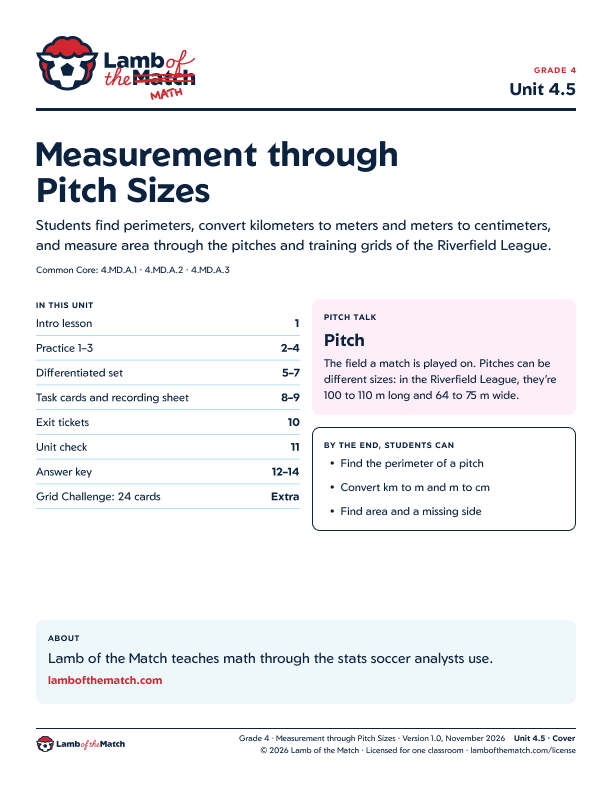
Every Grade 4 unit, from stadium crowds to pitch sizes. Five units for the price of four.

Grade 4 · Unit 4.5
Students learn measurement on the Riverfield League’s pitches, which all come in slightly different sizes. They find perimeters, convert kilometers, meters, and centimeters, and work out area and missing sides with training grids.
Print-at-home PDFs, licensed for one teacher’s classroom. Final sale once downloaded; see returns and refunds. Your order email has the download link.
What kids learn
Three Grade 4 Common Core standards, each practiced with numbers from a soccer season.
Convert meters to centimeters: the penalty spot is 11 m from the goal line, or 1,100 cm.
Order pitches by perimeter: the Otters’ pitch is 370 m around, the Turtles’ 328 m.
Find a training grid’s area: a 20 m by 15 m grid covers 20 × 15 = 300 m².
The stat behind it
In the Riverfield League, pitches are 100 to 110 meters long and 64 to 75 meters wide, so every club’s is a little different. Around the Robins’ pitch, 100 m by 64 m, is 100 + 64 + 100 + 64 meters.
328 m = 100 + 64 + 100 + 64
Try one
The challenge question from the unit’s third practice page. Every problem is set in the Riverfield League, with numbers from its season.
The Bison’s pitch is 105 m by 68 m. The Otters’ pitch is 110 m by 75 m. How many square meters bigger is the Otters’ pitch?
1,110 m² bigger! 110 × 75 = 8,250 and 105 × 68 = 7,140, so 8,250 − 7,140 = 1,110.
What’s in the pack
Print-at-home PDFs: an intro lesson, three practice pages, a differentiated set at three levels, 12 task cards with a recording sheet, exit tickets, a unit check, a 4-page teacher guide, a 3-page answer key, and Grid Challenge.
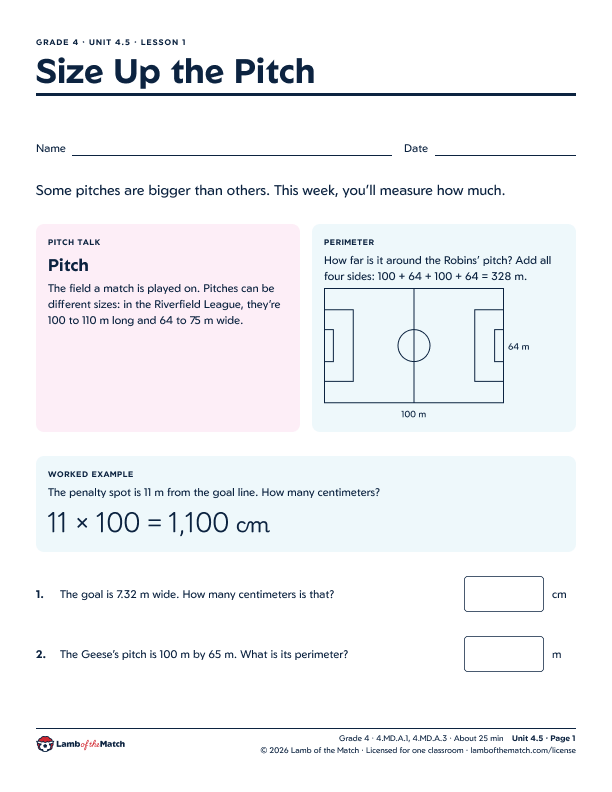
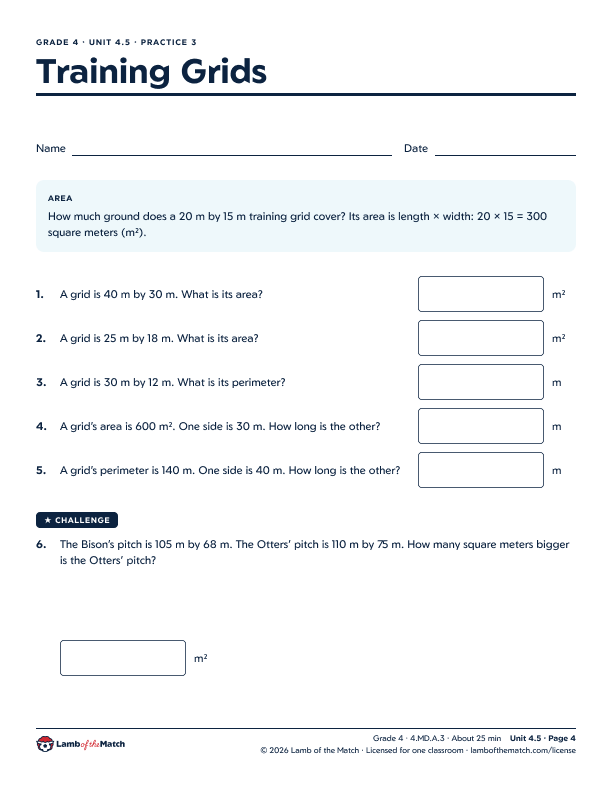
An intro lesson with a Pitch Talk on pitch sizes, then three practice pages.
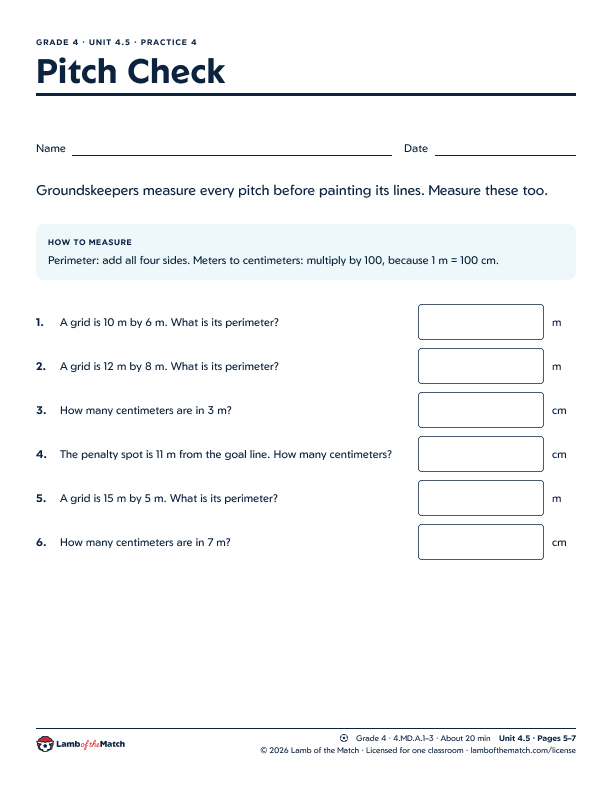
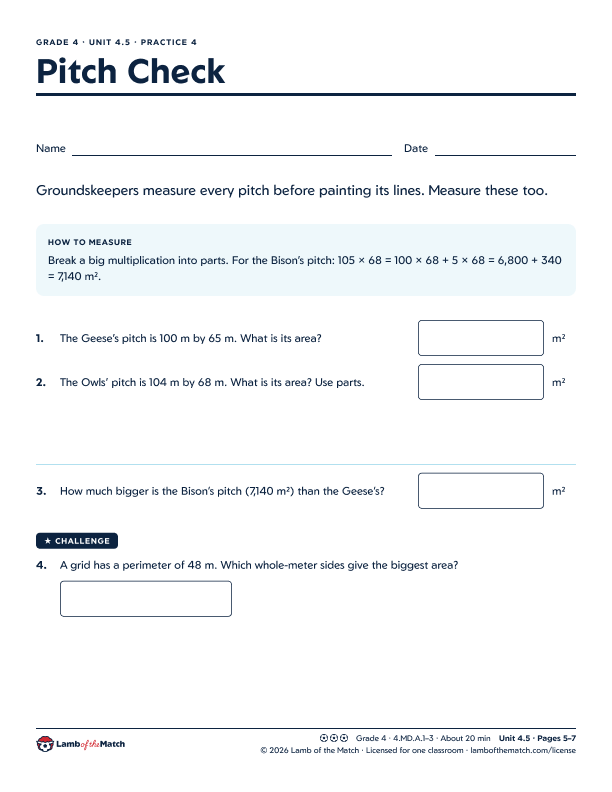
One measuring task at three levels: small grids in whole meters, then pitch perimeters and missing sides, then whole-pitch area with partial products.
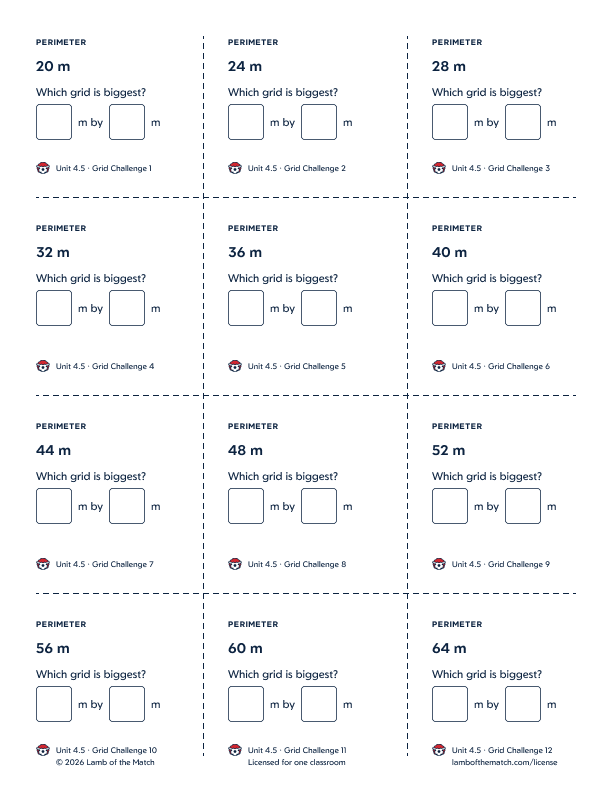
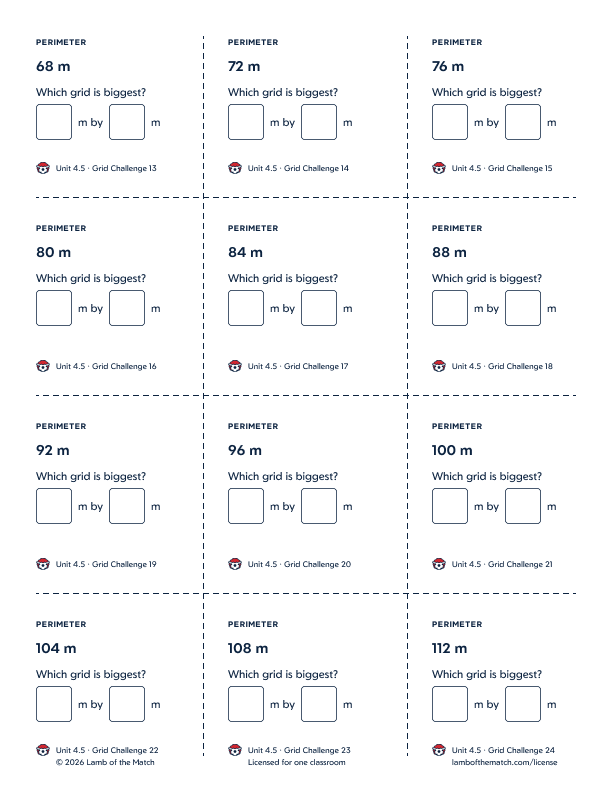
Play in pairs: flip a perimeter card, and each player finds the grid with whole-meter sides, that perimeter, and the biggest area. The player with the bigger area wins the card, and the winning grids are always squares, or as close to square as possible.
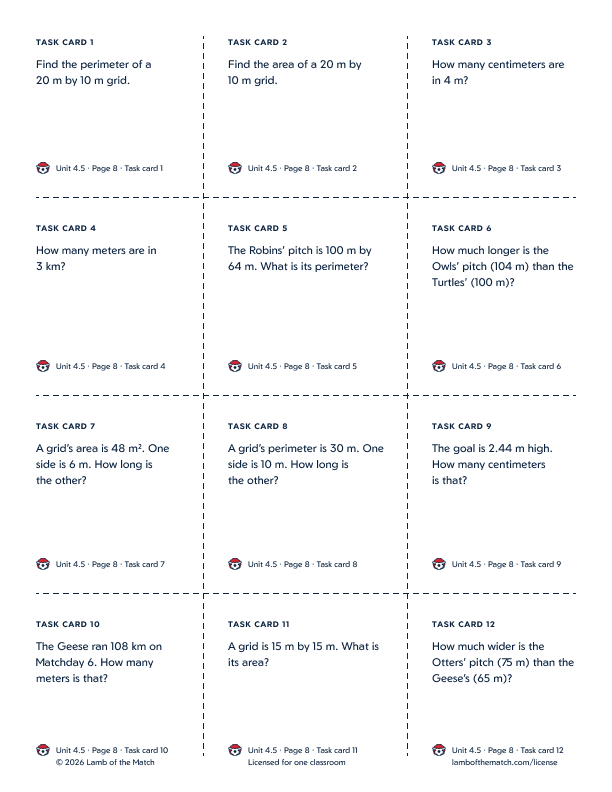
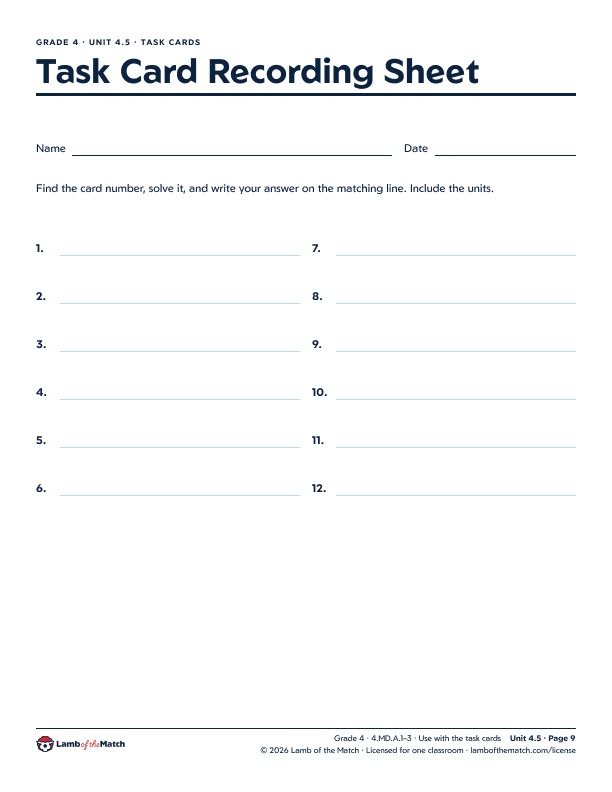
Cut-apart cards for centers or a scoot game, 12 in all, with a recording sheet.
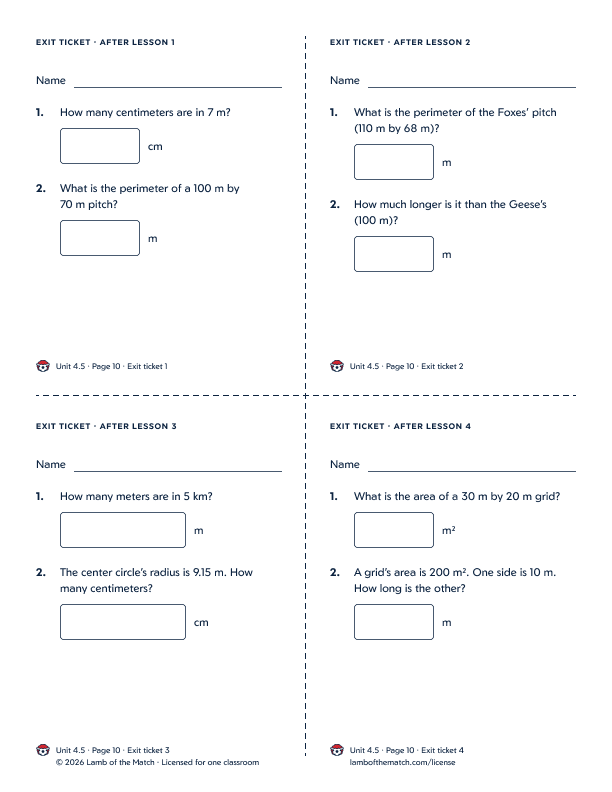
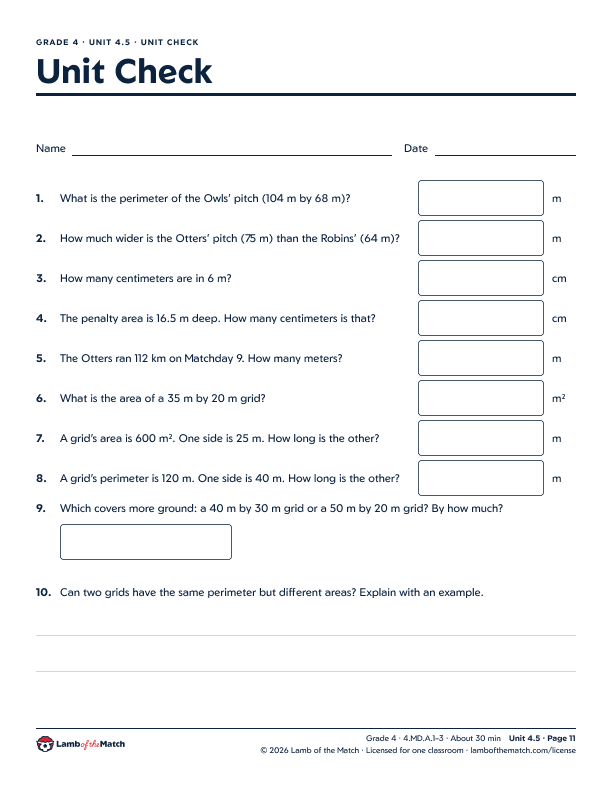
A quick ticket after each lesson, then a 10-question check to close the unit.
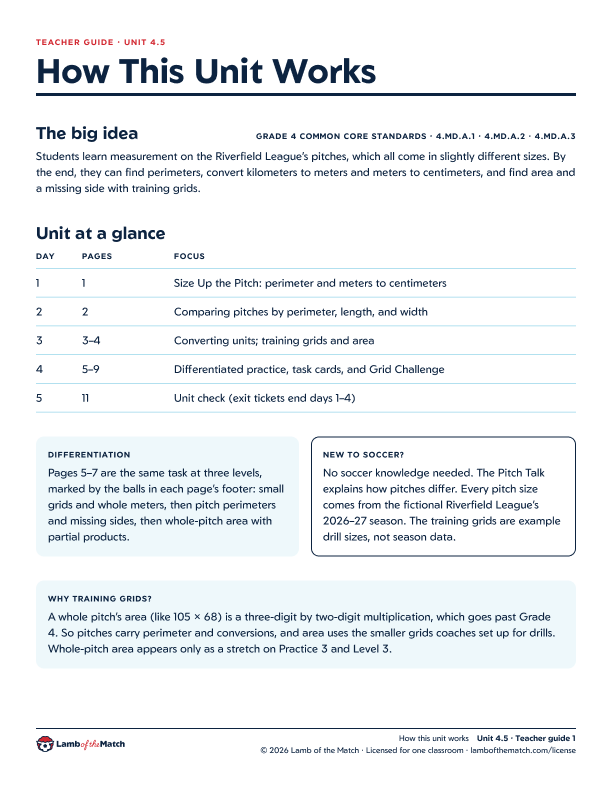
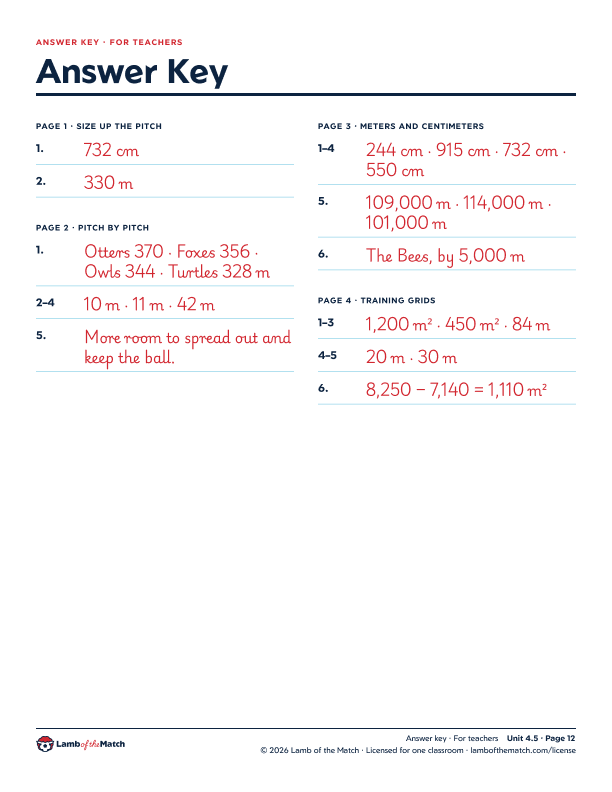
Lesson notes, the game rules, and every answer handwritten in red.
For teachers
Each lesson ends with a quarter-page ticket, so you can see who has it before moving on.
Everyone works on the same task at their own level. Only a small mark in each page’s footer shows the level, so the class can discuss it together.
A whole pitch’s area is a multiplication past Grade 4, so pitches carry perimeter and conversions, and area uses smaller training grids. Whole-pitch area appears only as a stretch, on Practice 3 and Level 3.
A Pitch Talk explains why pitches differ in size on the first page. Kids who love the game just get more to talk about.
Where it fits
Five units per grade, each built on a different soccer number. Grade 4 is out now, and Grades 3 and 5 are next.
Print-at-home PDFs, licensed for one teacher’s classroom. Final sale once downloaded; see returns and refunds. Your order email has the download link.
Five units per grade
Grade 4
Pick up the next unit, or get the whole grade for the price of four.
Grade 4 · All units
Every Grade 4 unit, from stadium crowds to pitch sizes. Five units for the price of four.
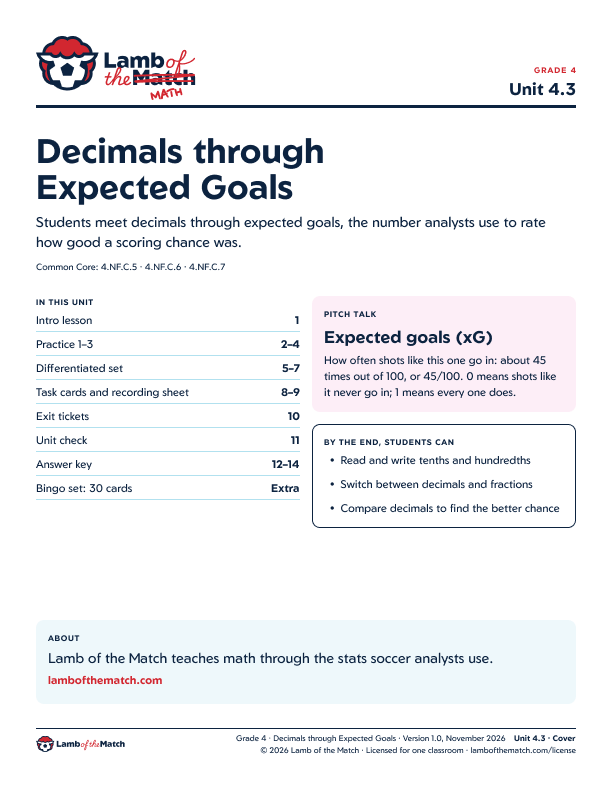
Grade 4 · Unit 4.3
What 0.45 expected goals really means: tenths, hundredths, and comparing decimals.
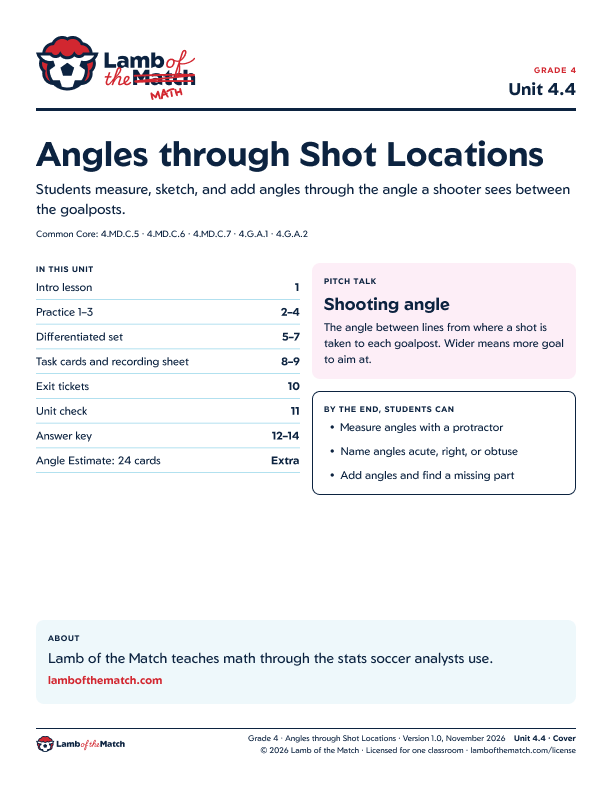
Grade 4 · Unit 4.4
How much of the goal a shooter can see: measuring, drawing, and adding angles.
Your cart is empty.
Find a lesson for your class, or something to wear to the match.